
Your State Requires Free Period Products. Here's How to Actually Comply.

Updated: Aug 10
If you manage facilities for a school, university, government building, or commercial property, there is a good chance your state already requires you to provide free period products. As of early 2026, 27 states and Washington D.C. have passed laws mandating free menstrual products in some combination of schools, public buildings, or workplaces. More legislation is moving through state houses every session.
The problem is that most of these laws tell you what to provide but not how. They say "make period products available in restrooms" without specifying what kind of dispenser, where exactly in the restroom, how to restock, or how to budget for it. That leaves facilities teams to figure it out on their own, and many end up defaulting to a basket on the counter or an old coin-operated dispenser switched to free-vend. Neither approach works well long-term.
This guide breaks down what the laws actually require and how to implement a system that stays compliant without creating a maintenance headache.
A requirement shouldn't create a maintenance problem.
UNICORN puts period products inside every stall with a simple cartridge system designed for commercial facilities. Install in 30 seconds. Refill in 10. Keep products where they're actually needed.
What Most State Laws Require
The specifics vary by state, but most period product mandates share a few common elements.
Products required. Nearly all laws specify both pads and tampons must be available. A few states also allow menstrual cups or panty liners. Providing only one type of product will not satisfy most mandates.
Location. Most laws require products in female and gender-neutral restrooms. Some states specify a minimum number of restrooms per building. Oregon, for example, requires products in at least two student restrooms per school building.
Grade levels. School mandates vary widely. Some states cover grades 6 through 12. Others include elementary schools starting at grade 4. A few extend to public universities and community colleges.
Cost to the user. All mandates require products to be free. Coin-operated dispensers do not satisfy the requirement unless they are converted to free-vend or replaced entirely.
Funding. This is where it gets uneven. Some states like California, Colorado, Connecticut, Hawaii, Maryland, Minnesota, New Jersey, New Mexico, Ohio, and Oregon provide dedicated funding to support the mandate. Others pass unfunded mandates, leaving the facility or district to absorb the cost.
States with Active Requirements (as of Early 2026)
The following states and D.C. have enacted laws requiring free period products in schools, public buildings, or both. Requirements vary in scope, grade level, and funding.
California, Colorado, Connecticut, Delaware, Hawaii, Illinois, Maine, Maryland, Minnesota, Missouri, Nebraska, Nevada, New Hampshire, New Jersey, New Mexico, New York, North Carolina, Ohio, Oregon, Pennsylvania, Rhode Island, South Carolina, Utah, Vermont, Virginia, Washington, and Washington D.C.
Additional states including Alabama, Georgia, and North Carolina provide funding for voluntary programs without mandating distribution.

Source: https://period.org/
At the federal level, the Menstrual Equity for All Act (H.R. 3644) was reintroduced in 2025. If passed, it would require employers with 100 or more employees to provide free period products and mandate free products in federal buildings, schools receiving federal funding, and correctional facilities.
Important: This list changes frequently as new legislation passes. Check your state legislature's website or contact your state department of education for the most current requirements.
The Compliance Gap: What Laws Say vs. What Actually Happens
Passing a law is one thing. Implementation is another.
The most common compliance failure is providing products in a way that technically satisfies the law but functionally does not work. This includes putting a basket of loose products on the counter that gets messy and runs out within hours, converting an old coin-operated dispenser to free-vend when the mechanism still jams constantly, stocking products in one restroom per building when high-traffic restrooms on other floors are empty, and assigning restocking to staff who already have full workloads without adjusting their schedules.
The result is a building that is technically compliant on paper but has empty dispensers and frustrated users in practice. When a dispenser is always empty, it sends a worse signal than having no dispenser at all. It says the institution tried and stopped caring.
How to Actually Implement This
Here is a practical implementation framework that keeps you compliant without creating ongoing operational problems.
Step 1: Audit your restrooms.
Walk every restroom in your building or campus. Count the stalls. Note which restrooms are high-traffic, which are low-traffic, and which are gender-neutral. This gives you the scope of what you need to stock.
Step 2: Choose the right dispenser for your environment.
This is the decision that determines whether the program succeeds or quietly fails within six months. There are three main options.
Counter baskets are the cheapest upfront but the most expensive in ongoing labor. Someone has to tidy and restock them daily. They get messy fast and products are exposed to water from sinks. Products are also outside the stall, which creates awkwardness for the user.
Wall-mounted dispensers outside the stall are the traditional approach. Many schools and public buildings already have these installed. The challenge is that legacy models are low-capacity, prone to jamming, and slow to restock since products have to be loaded individually. If your existing dispensers are coin-operated, you will need to either convert them or replace them.
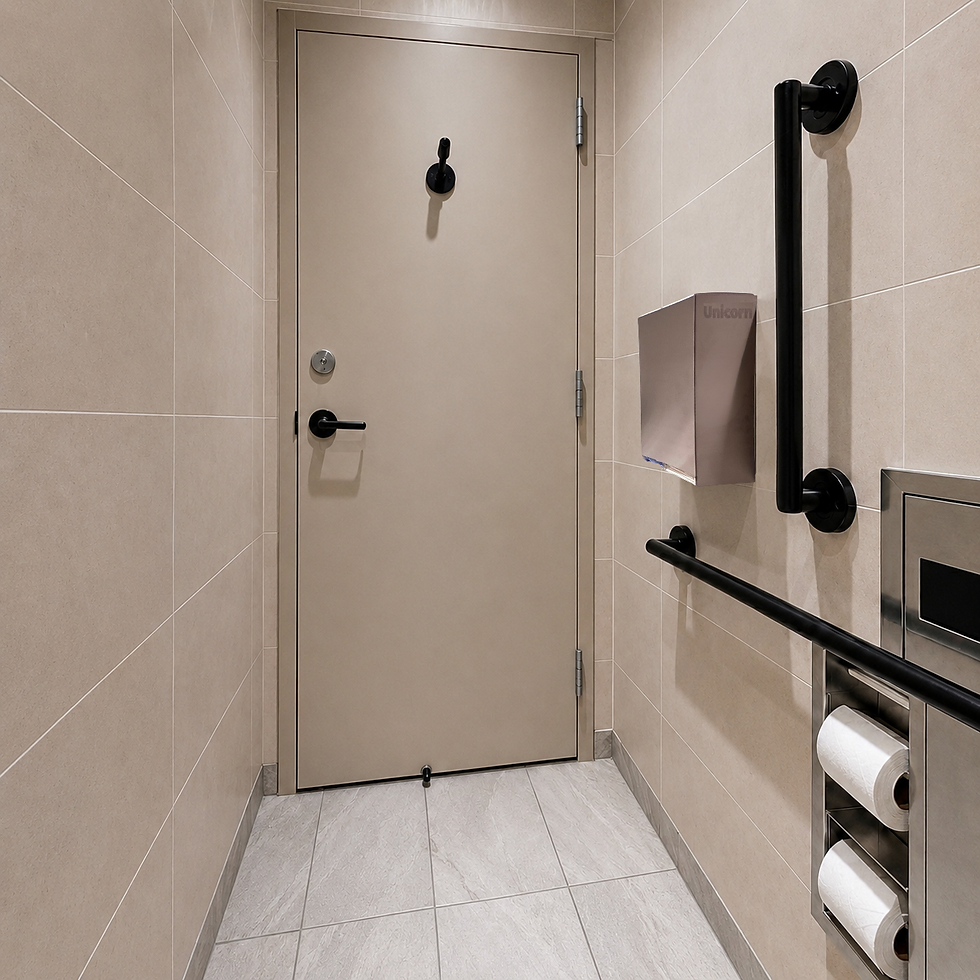
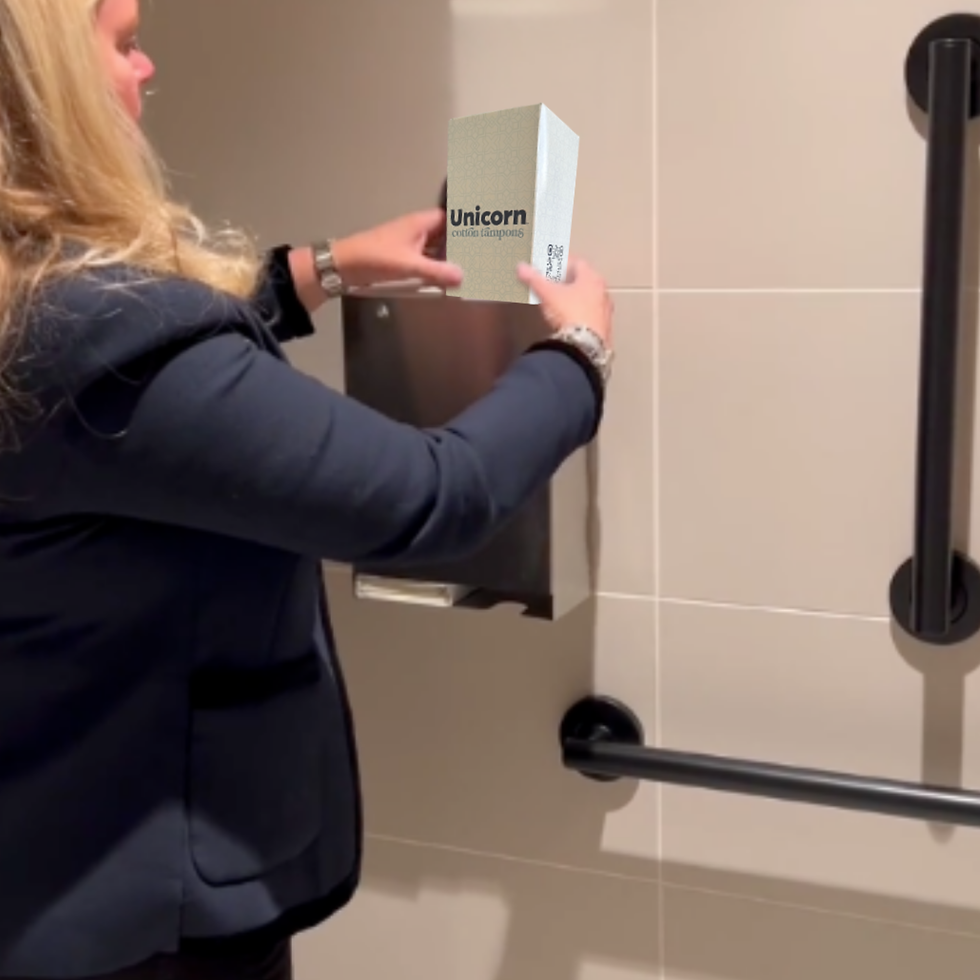
In-stall dispensers mount inside the stall next to the toilet, functioning like a toilet paper holder. Products are always within reach. Modern in-stall systems use pre-packed cartridges that swap in seconds, which dramatically reduces restocking time.
UNICORN's patent-pending stainless steel dispenser installs in 30 seconds with peel-and-stick adhesive and restocks in 10 seconds per cartridge. This approach is being used by enterprise facilities teams at JPMorgan Chase, American Express, Toyota, Pepsi, and Taco Bell.
Step 3: Plan your supply chain.
The biggest reason compliance programs fail is that restocking becomes somebody's problem but nobody's priority. The fix is integrating period products into the same supply chain and restocking schedule you already use for toilet paper and paper towels.
If your building orders supplies through a distributor like Staples, WB Mason, or BradyPLUS, add period product refills to the same purchase order. If you use a janitorial service, add period product checks to their existing restroom checklist. The goal is to make it invisible, not a separate task, not a special order, not someone's side responsibility.
Step 4: Budget realistically.
Facilities managers consistently overestimate the cost of providing free period products. The ongoing cost of refills is less than what the building already spends on paper towels per restroom.
For the dispenser hardware, some systems including UNICORN's in-stall dispenser can be provided at no upfront cost depending on the program. The total cost depends on the number of stalls, not the number of restrooms. Even when there is a hardware cost, cartridge-based in-stall systems typically pay for themselves quickly in reduced labor since they eliminate the daily tidying, hand-loading, and maintenance calls that baskets and traditional dispensers require.
If your state provides funding for compliance, apply for it. Several states offer grants ranging from $1,000 to $5,000 per district or building. Even partial funding can cover the upfront dispenser cost and the first year of product supply.
Step 5: Communicate it.
Compliance is not just about having products in the restroom. Several states require schools to actively communicate the availability of free period products to students. Even in states that do not require communication, a simple sign in the restroom ("Free period products available in every stall") normalizes the program and increases usage.
Do not make it a big announcement. The less institutional fanfare, the more it feels like infrastructure rather than a special program.
Staying Compliant Long-Term
The most common way compliance lapses is not that someone removes the products. It is that restocking gradually stops. The basket gets emptied and nobody refills it for a week. The dispenser jams and nobody submits a maintenance request. A new custodial team takes over and period products are not on their checklist.
Build these safeguards into your process. Add period products to your restroom inspection checklist, the same one that covers toilet paper, soap, and paper towels. Use cartridge-based dispensers that make restocking fast enough that it actually gets done. Track usage for the first 90 days to establish a baseline restocking frequency. Assign ownership to the same person or team responsible for overall restroom supplies.
Resources
For more information on implementing in-stall period care systems, visit everystall.com or contact unicorn@everystall.com.
UNICORN products are available direct or through Staples, WB Mason, HD Supply, Imperial Dade, BradyPLUS, and others. Essentially, wherever you get your toilet paper from.
Related posts:
FAQ Section
Which states require free period products in schools? As of early 2026, 27 states and Washington D.C. have passed laws requiring free period products in schools. States with active mandates include California, Colorado, Connecticut, Delaware, Hawaii, Illinois, Maine, Maryland, Minnesota, Nevada, New Hampshire, New Jersey, New Mexico, New York, Ohio, Oregon, Pennsylvania, Rhode Island, Utah, Vermont, Virginia, Washington, and others. Requirements vary by state in grade level coverage and funding.
Do employers have to provide free period products? Currently, no federal law requires private employers to provide free period products. However, the Menstrual Equity for All Act (H.R. 3644), reintroduced in 2025, would require employers with 100 or more employees to do so. Some states and municipalities have workplace requirements. Many large employers including JPMorgan Chase, American Express, and Toyota provide them voluntarily.
How much does it cost to comply with period product mandates? The ongoing cost of period product refills is less than paper towel costs per restroom. Several states offer grants ranging from $1,000 to $5,000 per building or district to offset the cost of dispensers and product supply.
What is the best way to provide free period products for compliance? In-stall dispensers provide the most reliable compliance because products are visible, accessible, and integrated into normal restroom operations. UNICORN's stainless steel in-stall dispenser installs in 30 seconds and restocks in 10 seconds with pre-packed cartridges, making it practical for facilities teams to maintain across multiple restrooms.
What happens if our building is not compliant with period product requirements? Enforcement varies by state. Some states conduct audits or require reporting. Others rely on complaints. Regardless of enforcement mechanisms, empty or non-functional dispensers undermine the intent of the law and create negative experiences for building occupants.

Comments