
Best Practices for Providing Accessible Period Products at Your Workplace

Updated: Aug 11
Most workplaces that decide to provide period products get the intention right and the execution wrong.
They put a basket on the bathroom counter. Or install a wall-mounted dispenser by the sinks. Or designate one restroom on one floor as the place to go. And then, a few months later, the basket is empty, the dispenser is jammed, and the program quietly disappears.
Accessibility is not just about having products available somewhere in the building. It is about having the right products, in the right place, in a system that actually stays stocked. These are the best practices that make the difference between a period care program that works and one that looks good on paper.

1. Put Products Inside Every Stall
This is the single most important thing a workplace can do, and most get it wrong.
The standard approach is to mount a dispenser on the wall outside the stall, near the sinks or the restroom entrance, with one unit serving the whole restroom. The logic makes sense on the surface. In practice, it fails for most of the people it is meant to serve.
The moment of need happens inside the stall. A person who realizes they need a product once they are already seated has to make a choice: get up, leave the stall, cross the restroom, get a product, and come back, or improvise. Most people improvise. Or they leave the building entirely. That is the gap a basket by the sinks will never close, no matter how well stocked it is.
For employees with mobility impairments, leaving the stall to retrieve a period product is not just inconvenient. It may not be possible. Wheelchair users, people with chronic pain conditions, and others with limited mobility face a real access barrier when the product is on the other side of a restroom door. Placing period products outside the stall and calling it accessible period care is not the same thing.
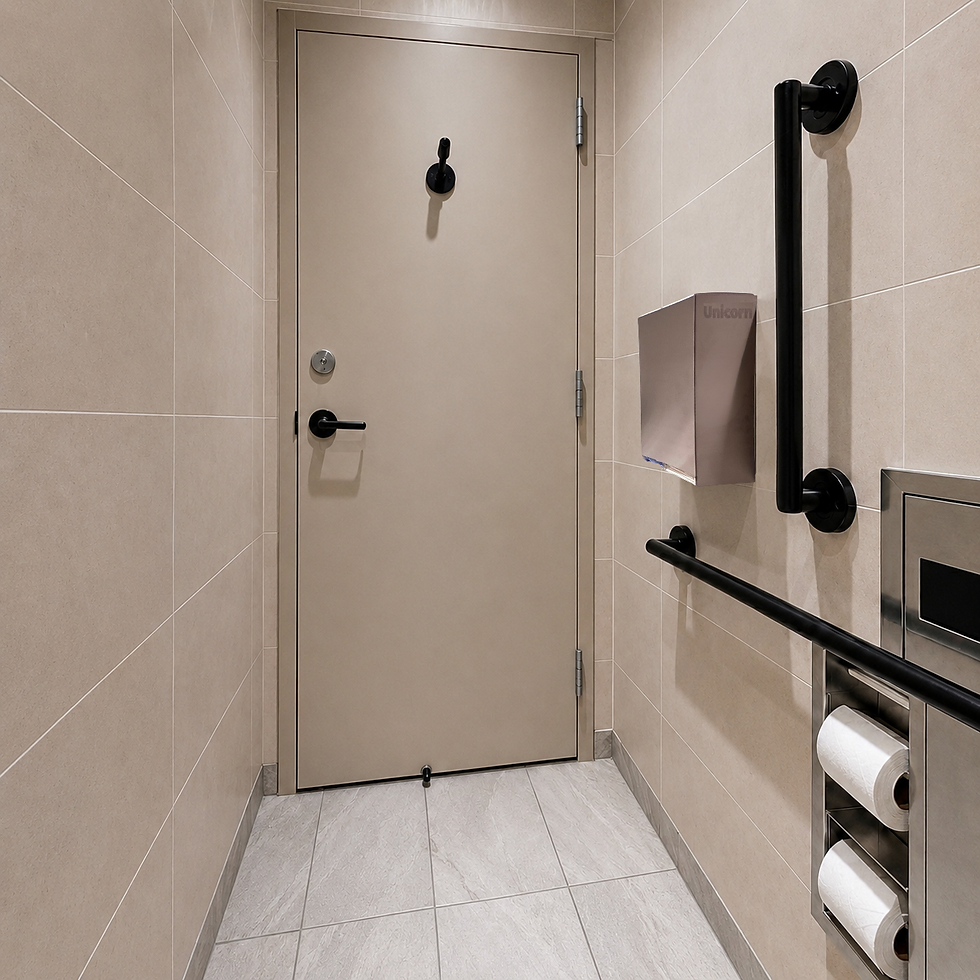
In-stall placement solves both problems at once. The product is right there, within arm's reach, the same way toilet paper is. No planning ahead. No leaving. No asking anyone. One dispenser per stall, in every applicable restroom in the building, is the standard that actually works.
This is the model supported by the WELL Building Standard under Feature W08.1 (Hygiene Support), which specifies products should be available within each toilet stall, and Feature C13.1 (Accessibility and Universal Design), which addresses equitable access for people of all abilities. UNICORN is the first period product dispenser approved for alignment with both features under the Works with WELL program.
Enterprise organizations including JPMorgan Chase, American Express, and Toyota have moved to this model. The reason is not just employee experience. It is that one dispenser per restroom is not coverage. It is the appearance of coverage.
Best practice: Install one dispenser inside each stall, in every women's restroom and all-gender restroom in the building.
2. Account for ADA and Mobility Accessibility
Period care access and ADA compliance are not typically discussed in the same conversation. They should be.
The Americans with Disabilities Act requires that facilities provide equal access to goods, services, and amenities for people with disabilities. When a period product dispenser is mounted outside a restroom stall, or requires a person to navigate through a multi-stall restroom to reach it, the program may not be meeting that standard for everyone it is supposed to serve.
This is not a hypothetical edge case. Approximately 26% of adults in the United States live with some form of disability. Mobility impairments are among the most common. An employee who uses a wheelchair, a walker, or has limited lower body mobility may physically be unable to exit the stall, retrieve a product, and return without significant difficulty or assistance. That is not equal access.
The practical fix is the same as the placement fix: dispenser inside the stall, within arm's reach, requiring no exit. But it is worth naming explicitly because ADA accessibility gives the conversation a different weight in facilities and legal discussions. This is not a wellness perk. It is an access obligation.
For organizations pursuing WELL certification, UNICORN's alignment with Feature C13.1 (Accessibility and Universal Design) directly supports this requirement.
Best practice: Evaluate period product placement through an ADA accessibility lens, not just an employee experience lens. In-stall placement is the only model that serves employees of all abilities without requiring them to leave the stall.
3. Provide Both Tampons and Pads
A period care program that only offers tampons is not fully accessible. Neither is one that only offers pads. People have different needs, different preferences, and different reasons for choosing one product over the other. Both need to be available.
This matters practically as well as philosophically. An employee who relies on pads and finds only tampons in the dispenser is not served by the program, even if the dispenser is full.
UNICORN's in-stall dispenser holds both a tampon cartridge and a pad cartridge in a single unit, so both products are available in the same stall without requiring a second dispenser or a second visit.
Best practice: Stock both tampons and pads in every dispenser location.
4. Choose Products People Will Actually Use
Product quality determines whether the program gets used. A dispenser stocked with products no one wants is functionally the same as an empty dispenser.
The clearest signal on this comes from retail data. Today, 88% of tampon sales are non-cardboard applicators. Cardboard applicators are uncomfortable and widely avoided by the people who have a choice. In a workplace setting, where the products are provided rather than chosen, employees do not have that choice. They get what is in the dispenser.
Organic cotton products with plant-based applicators are what most people buy when they have a choice. That is the standard a workplace period care program should meet.
Best practice: Stock organic cotton products with plant-based applicators. Avoid cardboard.
5. Build Restocking Into Existing Workflows
The most common reason period care programs fail is not budget. It is restocking.
Traditional dispensers require unlocking with a key, opening the housing, and hand-loading individual products one at a time. The process takes three to five minutes per dispenser. In a building with 20 stalls, that is over an hour of custodial time just for period products. When schedules are tight, that task is the first to get deferred.
Deferred once, deferred twice, and the dispenser is empty by the end of the month.
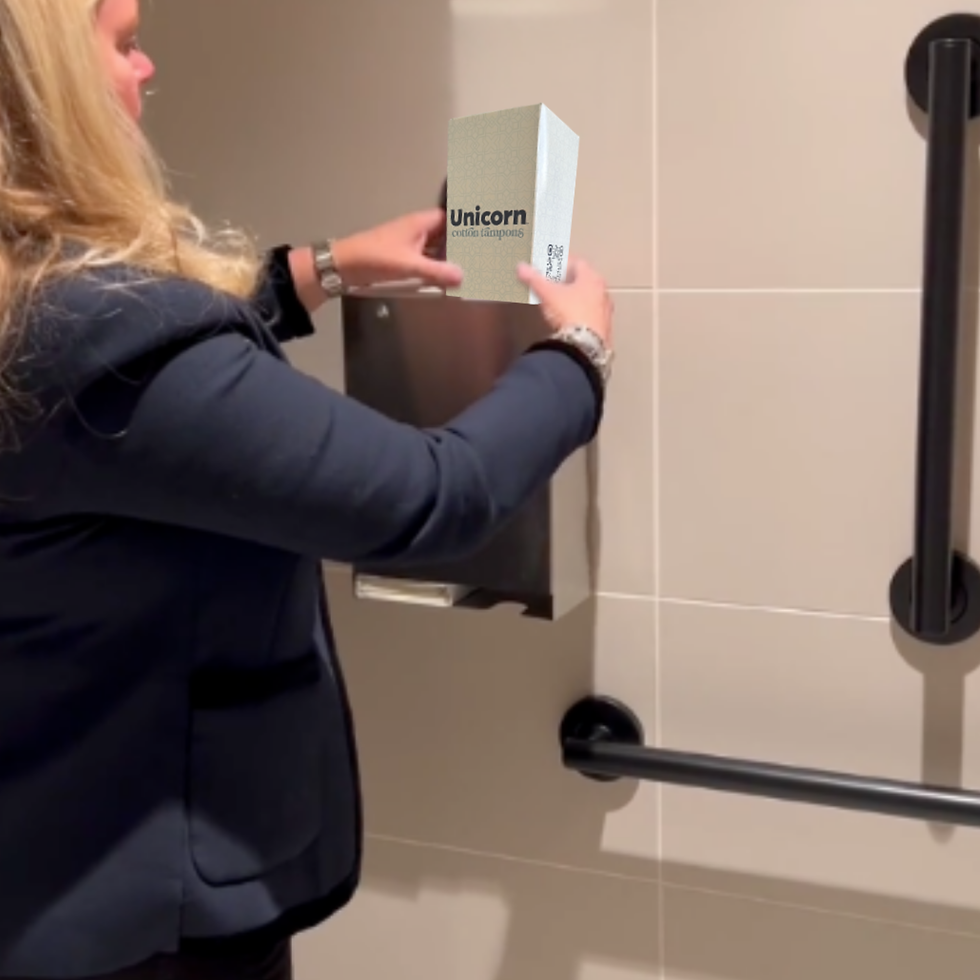
The fix is not more time or more staff. It is a system where restocking period products takes no longer than swapping a toilet paper roll. Cartridge-based systems make this possible. A pre-packed cartridge slides out, a full one slides in. UNICORN's cartridge swap takes 10 seconds. That is fast enough to be part of the same restroom round that covers toilet paper, soap, and paper towels, without adding meaningful time to the task.
Best practice: Use a cartridge-based dispenser system and integrate restocking into existing custodial rounds rather than treating it as a separate task.
6. Order Through Your Existing Supply Chain
Period products need to show up on the same purchase order as toilet paper and paper towels. If they require a separate vendor, a separate ordering process, or a separate delivery schedule, someone will eventually forget. And when products run out and the reorder is delayed by two weeks, the program fails.
UNICORN refill cartridges are available through the same facility supply distributors most enterprise organizations already use: Staples, WB Mason, BradyPLUS, HD Supply, and Imperial Dade. Adding period products to an existing supply order takes a few seconds. Maintaining a separate vendor relationship requires ongoing attention that rarely gets it.
Best practice: Source period product refills through your existing distributor. Treat them as a standard restroom consumable, the same as toilet paper.
7. Communicate That Products Are Available
Accessibility requires awareness. Employees who do not know period products are available in the restrooms will not benefit from them, even if every stall is stocked.
This does not require a formal campaign. A brief note in onboarding materials, a mention in a facilities update, or a line in the restroom policy is enough. The goal is simply that employees know they do not need to keep products in their desk drawer or leave the building to buy something.
For organizations pursuing WELL certification, employee communication about restroom amenities is part of the program documentation.
Best practice: Include period product availability in onboarding materials and any facilities or workplace communications.
8. Treat It as Infrastructure, Not a Program
The organizations that sustain period care access long-term are the ones that stop thinking of it as a wellness initiative and start thinking of it as restroom infrastructure.
Toilet paper is not a program. Hand soap is not a program. Neither is period care. When it is treated as a perk or a benefit, it is subject to budget reviews, program audits, and the question of whether it is still worth doing. When it is treated as a standard restroom consumable, it just gets restocked.
The practical implication is simple: period products go on the same supply list, the same restocking checklist, and the same facilities budget line as every other restroom consumable. Once it is in the system as infrastructure, it stays.
Best practice: Put period care on the facilities budget, not the HR or wellness budget. Manage it the same way you manage toilet paper.
The Accessible Period Care Checklist
✔ Dispensers are mounted inside each stall, not outside or by the sinks
✔ Every stall in every applicable restroom has a dispenser
✔ Placement has been evaluated for ADA accessibility -- no stall exit required to access products
✔ Both tampons and pads are available in each location
✔ Products are organic cotton with plant-based applicators
✔ Restocking takes seconds, not minutes, using a cartridge-based system
✔ Refills are ordered through your existing facility supply distributor
✔ Employees know products are available through onboarding or facilities communications
✔ Period care is on the facilities budget as a standard restroom consumable
Frequently Asked Questions
What does accessible period care at work actually mean? Accessible period care means products are available inside each restroom stall, stocked consistently, and include both tampons and pads. Accessibility breaks down when products are placed outside the stall, only available in one restroom per floor, or stocked inconsistently.
Where should period products be placed in a workplace restroom? Inside each stall, within arm's reach of the toilet. Outside-the-stall or counter placement requires employees to plan ahead or leave the stall, which reduces access at the moment it is most needed.
Does ADA apply to period product dispensers in the workplace? The ADA requires equal access to workplace amenities for employees with disabilities. When period products are only accessible outside a restroom stall, employees with mobility impairments may be unable to retrieve them without assistance or leaving the stall entirely. In-stall placement is the only model that ensures access regardless of mobility status. UNICORN's dispenser is designed for in-stall installation and supports WELL Feature C13.1 (Accessibility and Universal Design).
Should workplaces provide tampons, pads, or both? Both. Employees have different needs and preferences. A program that only stocks one product type is not fully accessible to everyone it is meant to serve.
What type of period products should a workplace provide? Organic cotton products with plant-based applicators. Cardboard applicators are uncomfortable and widely avoided -- 88% of tampon purchases are non-cardboard. Providing products people actually want to use is what makes a period care program effective.
How do you keep workplace period product dispensers consistently stocked? Use a cartridge-based dispenser system that restocks in seconds rather than minutes, and integrate restocking into existing custodial rounds. UNICORN's cartridge system takes 10 seconds to restock per dispenser, making it practical to include alongside toilet paper and soap checks.
How do you build the business case for accessible period care at work? The cost is lower than most people expect -- roughly one case of tampons and one case of pads per stall per year. Products are orderable through existing facility supply distributors. The operational overhead, when using a cartridge-based in-stall system, is minimal. The risk of doing nothing is increasingly a compliance issue as workplace period care mandates expand across states.

Comments